What Should I Eat to Build Muscle During Perimenopause?
Oct 25, 2026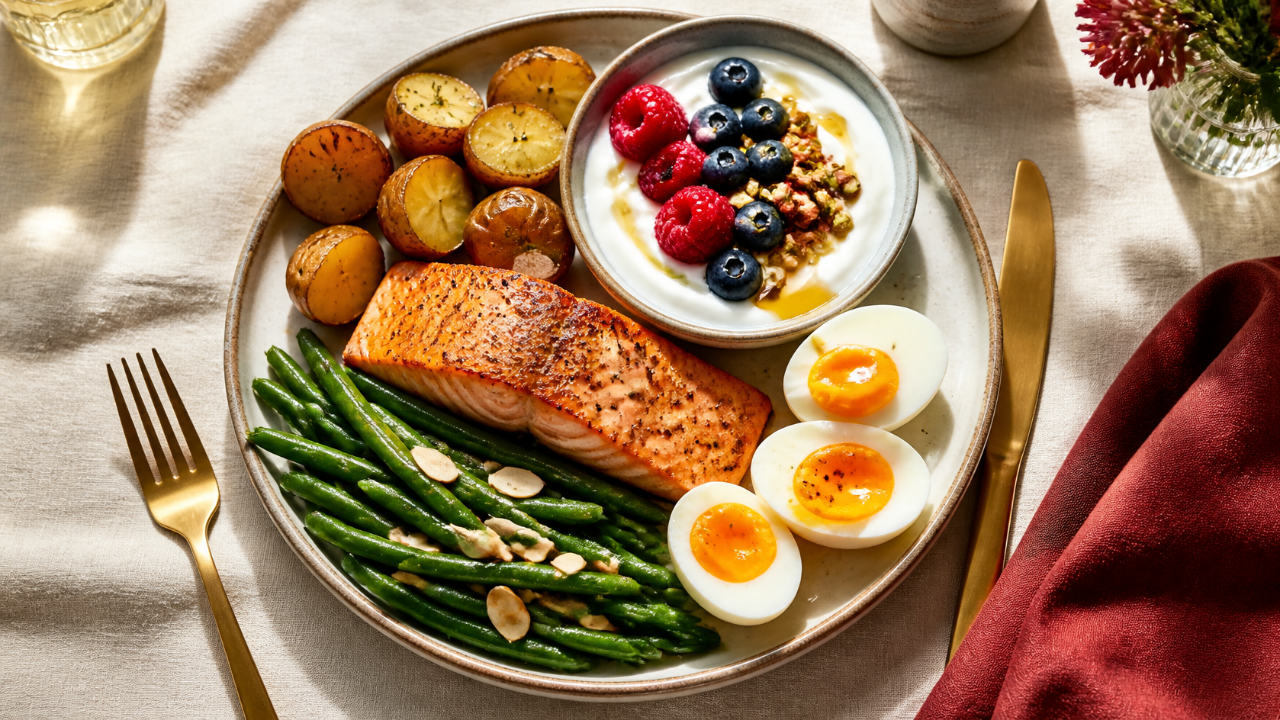
By LaTisha Fletcher, NBC-HWC (Coach Tish). National Board Certified Health and Wellness Coach for women 35 to 55.
She's doing the workouts. She's eating "healthy." Salad at lunch, a protein bar in the car, whatever's left on the kids' plates at dinner. And her arms still feel softer every year, her knees ache on the stairs, and the scale won't move.
Girl, I see you. And I'll tell you what I tell every woman I coach. You're probably not eating enough to build anything.
The short answer: To build and keep muscle in perimenopause, most women need more protein than they're eating now, spread across the day. Many experts now suggest about 0.55 to 0.7 grams of protein per pound of body weight daily for active midlife women. In real life, that usually means 25 to 40 grams of protein at each meal, paired with strength training two to three times a week. Enough total food matters too. Your body won't build muscle while it thinks it's starving.
Why does muscle get harder to build in perimenopause?
Estrogen does more than run your cycle. It helps your muscles respond to exercise and protein. As estrogen falls and fluctuates in perimenopause, your muscles get less responsive. Researchers call this "anabolic resistance." It means the same chicken breast and the same workout give you less muscle than they did at 30.
Women also lose muscle gradually with age, starting as early as their 30s. Without strength training and enough protein, that loss speeds up in midlife.
That's why this matters so much. Muscle is the organ that helps you manage blood sugar, protect your bones, keep your balance, and carry your own groceries at 80. Building it is good stewardship of the body God gave you.
How much protein do I need in perimenopause?
Here's the simple math:
- Start with your weight in pounds.
- Multiply it by 0.55 for the low end and 0.7 for the high end. That's your daily protein range in grams.
Example: A woman who weighs 160 pounds multiplies 160 by 0.55 and 160 by 0.7. Her range is roughly 90 to 112 grams of protein a day.
If you have a lot of weight to lose, using your goal weight instead of your current weight keeps the number realistic.
If you have kidney disease or another medical condition, check with your doctor before raising your protein.
Why does protein at each meal matter?
Your body can only use so much protein at once to build muscle. Midlife muscles need a bigger "dose" to get the message. Most women get a little protein at breakfast, a little at lunch, and a big piece of meat at dinner. That pattern leaves muscle-building on the table twice a day.
Aim for 25 to 40 grams at each meal. Breakfast is usually where women fall shortest, so start there.
What does 30 grams of protein look like?
Each of these lands around 25 to 35 grams:
- 1 cup of plain Greek yogurt with berries and a spoon of nut butter
- 3 eggs plus 1/2 cup of egg whites, scrambled with spinach
- 4 ounces of chicken breast, about the size of your palm plus a little more
- 1 cup of cottage cheese with fruit
- A can of tuna or salmon mixed into a salad or on toast
- 5 ounces of salmon, shrimp, or lean beef
- A protein shake made with one scoop of protein powder and milk
A day of eating for muscle in perimenopause
Here's one example. Adjust it to your body, your budget, and your table.
- Breakfast: Veggie egg scramble with whole-grain toast and fruit (about 30 grams of protein)
- Lunch: Big salad with chicken, chickpeas, avocado, and a vinaigrette (about 35 grams)
- Snack: Greek yogurt or a cheese stick with an apple (10 to 20 grams)
- Dinner: Salmon, roasted potatoes, and green beans (about 35 grams)
That lands near 110 to 120 grams. And notice something, sis. That's a lot of real food. Nobody's going hungry.
Do I need carbs to build muscle?
Yes. Carbs fuel your workouts and help you recover. Women who cut carbs hard often feel weak in the gym, sleep worse, and crave sugar at night. Choose slow carbs most of the time. Potatoes, oats, rice, beans, fruit, and whole grains all count.
Fiber matters too. Most women do well aiming for at least 25 grams a day from vegetables, fruit, beans, and whole grains.
What about creatine, vitamin D, and calcium?
- Creatine is one of the best-studied supplements for strength. Research in women, including midlife women, shows it can support muscle and strength when paired with lifting. A common dose is 3 to 5 grams a day.
- Vitamin D and calcium support bone health, which becomes a bigger deal as estrogen falls.
Talk with your healthcare provider before starting any supplement, especially if you take medication.
Food alone won't build muscle
Protein gives your body the building blocks. Strength training tells it to build. You need both.
Aim for two to three strength sessions a week that work your whole body. Squats, hinges like deadlifts, pushes, pulls, and carries. The weight should feel challenging by the last few reps. Over time, add a little more. That's called progressive overload, and it's how muscle gets the message.
You can start at home with dumbbells and a sturdy chair. You don't need a fancy gym.
Frequently asked questions
How much protein should a woman in perimenopause eat a day?
Many experts suggest about 0.55 to 0.7 grams per pound of body weight for active midlife women. For a 160-pound woman, that's roughly 90 to 112 grams a day.
Can you build muscle during perimenopause?
Yes. It takes more intention than it did in your 20s, but women build muscle in their 40s, 50s, and beyond with consistent strength training and enough protein.
Will eating more protein make me gain weight?
Protein is filling and helps you hold on to muscle, which supports a healthy metabolism. Most women find they snack less once their meals carry enough protein. Total calories still count, so build meals around protein instead of adding it on top of everything else.
What's the best protein for women over 40?
The best protein is one you'll eat consistently. Eggs, Greek yogurt, cottage cheese, fish, poultry, lean beef, tofu, tempeh, and beans all work. Animal proteins are richer in leucine, the amino acid that helps switch on muscle building, so plant-based women may need slightly larger portions.
Want the meals and workouts already done for you?
If you want this mapped out day by day, my Lose the Gut, Keep the Butt 30-Day Guide gives you protein-focused meals with the protein counted, 12 at-home strength workouts, and simple daily habits. It's $37.
And if you've spent years eating as little as possible, start with Eat More, Not Less. Feeding yourself well is where the rebuilding starts.
Up at night too? Read Why Am I Waking Up at 3AM During Perimenopause?
This article is for education and coaching support. It isn't medical advice. Talk with your healthcare provider about your health needs before changing your diet or adding supplements.
SUBSCRIBE FOR WEEKLY LIFE LESSONS
Lorem ipsum dolor sit amet, metus at rhoncus dapibus, habitasse vitae cubilia odio sed.
We hate SPAM. We will never sell your information, for any reason.